1. Executive Summary
ARCOS-B is a deterministic cognitive engine designed for structural code manipulation. Unlike General Purpose Large Language Models that treat code as probabilistic text completion, ARCOS-B operates within a structured, predictable framework.
The platform follows structured, deterministic processes that ensure consistent, reproducible outcomes. It runs entirely on local hardware with minimal latency.
ARCOS-B incorporates internal safeguards that maintain stability and output clarity, eliminating unpredictable behavior and ensuring that code transformations remain within defined boundaries.
2. Problem Statement
The integration of Generative AI into software engineering has introduced a critical reliability gap. While LLMs excel at generating boilerplate and explaining concepts, they fail to meet the rigorous requirements of automated refactoring and maintenance.
Key Challenges with Current Approaches:
- 1.Unpredictable Outputs: The same request can yield different results on subsequent runs, making automated pipelines unreliable.
- 2.Fabricated Content: Models may invent imports, alter logic, or introduce plausible but incorrect code when context is ambiguous.
- 3.Style Inconsistency: Models often rewrite valid code to match their training distribution, violating project-specific conventions.
- 4.Privacy Concerns: Standard approaches require sending code to remote endpoints, increasing exposure risk.
- 5.No Built-in Verification: Text-generation models do not inherently verify that output code compiles or maintains structural integrity.
3. Design Principles
ARCOS-B was built around core principles that enable reliable, industrial-grade code manipulation:
DETERMINISM
The platform produces identical results for identical inputs, enabling predictable automated workflows.
STRUCTURED REASONING
Reasoning operates within a stable, structured framework that maintains internal coherence throughout operations.
TARGETED OPERATIONS
Operations are precisely scoped to specific code regions, ensuring surrounding code remains untouched.
OUTPUT INTEGRITY
Outputs are validated conceptually before expression, ensuring consistency and correctness.
LOCAL EXECUTION
The system runs on consumer-grade hardware with low latency, removing dependencies on external services.
4. Architecture Overview
ARCOS-B organizes cognitive steps in a predictable architecture with distinct processing stages that maintain transparency and traceability throughout the transformation process.
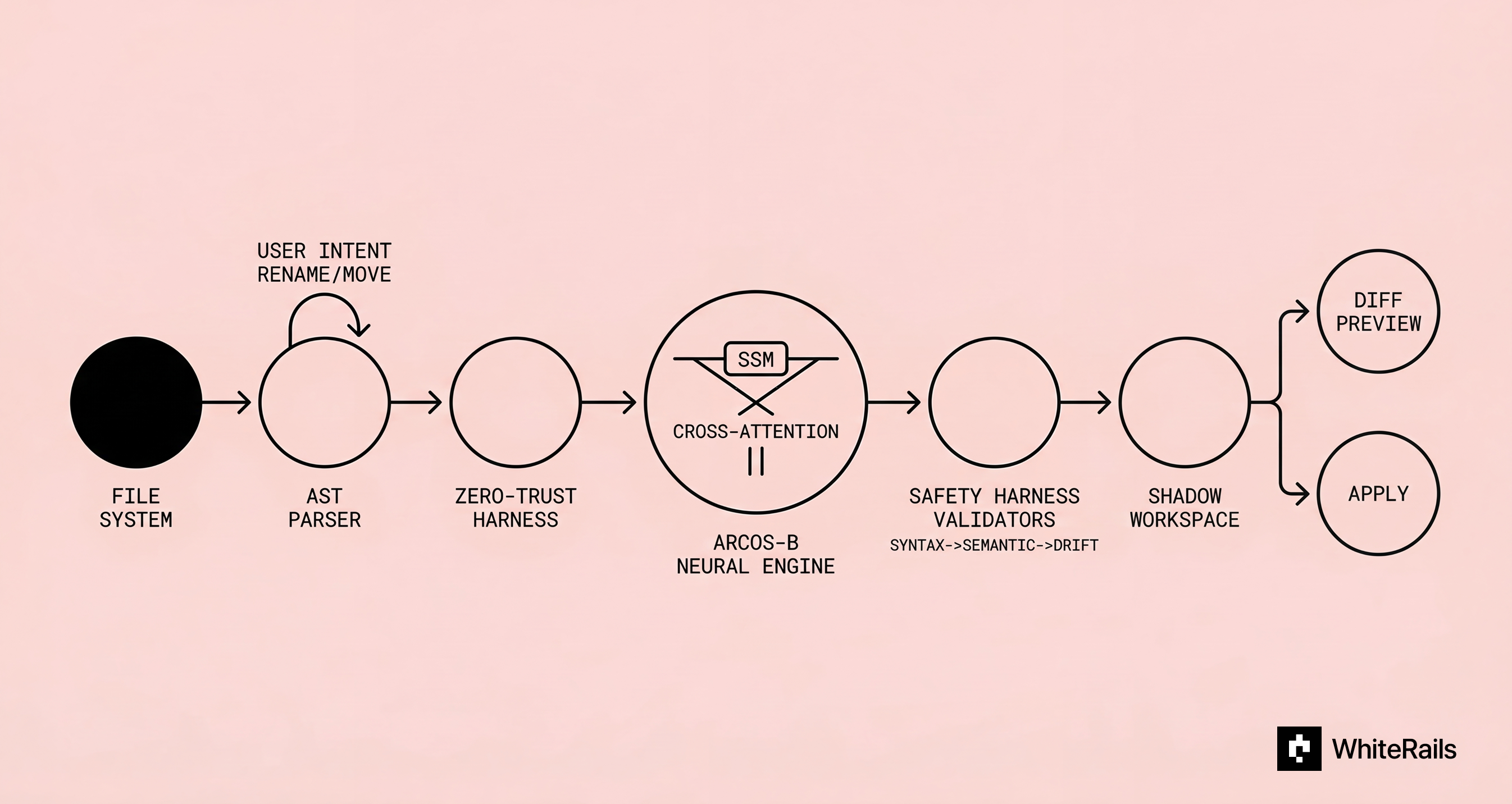
Key Characteristics
5. Trust Model
ARCOS-B operates on the principle that all computational components require verification. The system incorporates internal safeguards that maintain stability and prevent unintended modifications.
Isolated Operations
All transformations are performed in isolation with rollback guarantees. Changes are only applied after passing validation stages.
Scoped Context
The system operates with minimal context exposure, reducing potential for unintended side effects and maintaining focus on the target operation.
6. Output Guarantees
ARCOS-B applies internal consistency mechanisms to ensure outputs remain within defined boundaries. This approach is fundamentally different from prompt engineering or model fine-tuning.
KEY PROPERTIES
The platform relies on explicit structural representations that guide output generation within safe, predictable boundaries.
Core guarantees of the output system:
- 1.Contextually Bounded — Outputs are constrained to the operational context.
- 2.Task-Aligned — Results match the specified operation parameters.
- 3.Structurally Valid — All outputs conform to language syntax rules.
Pointer Hardening
Logit masking constrains decoder output
P(xt) = softmax(Lt ⊙ M)
Result
The system prevents generation of undefined references, invalid imports, or content that does not belong to the operational context—regardless of model configuration.
7. Validation
ARCOS-B uses layered static and dynamic validation before applying any change:
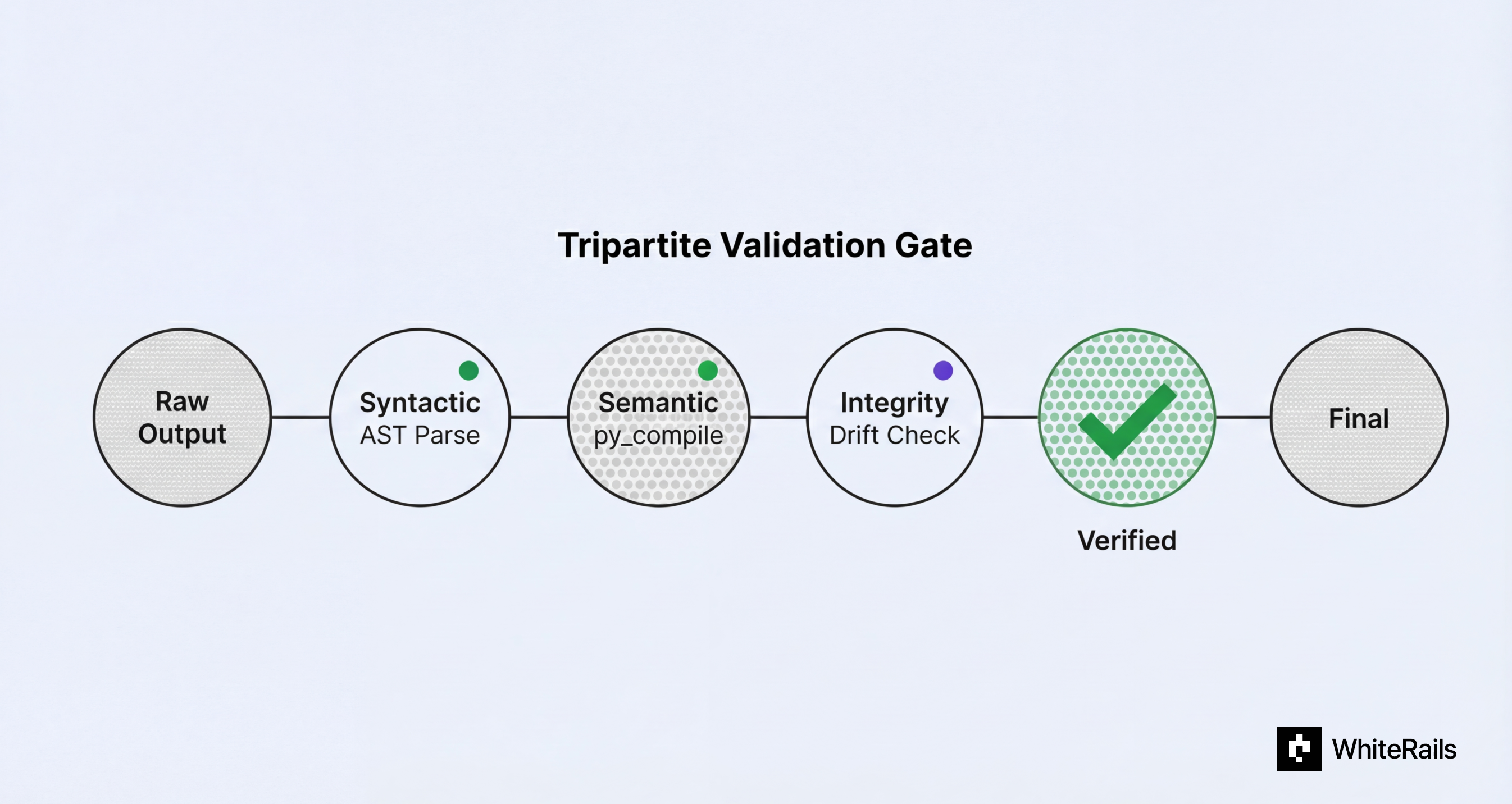
STRUCTURAL VALIDATION
Ensures all generated output is structurally valid and well-formed.
SEMANTIC VALIDATION
Verifies that transformations maintain semantic correctness and do not introduce errors.
INTEGRITY VALIDATION
Confirms that changes remain within the intended scope and do not affect surrounding code.
8. Interface
The primary interface for ARCOS-B is a CLI tool designed for integration into CI/CD pipelines or local development environments.
COMMAND STRUCTURE
The CLI accepts structured, atomic operations to ensure intent clarity. Natural language instructions are not supported.
Workflow
Operations follow a structured workflow: argument validation, context extraction, transformation, multi-layer validation, preview generation, and optional application with full logging.
9. Current Capabilities
As of v1.0, ARCOS-B supports deterministic operations within the Python domain:
Context-aware renaming of functions, classes, and variables.
Safe extraction and relocation of function definitions.
Injecting decorators without altering function body logic.
Enforcing specific import patterns or structural conventions.
Performance
- Latency: Sub-100ms per operation on consumer hardware
- Footprint: Lightweight, runs locally without cloud dependencies
10. Limitations
- •Scope: Optimized for function-level or class-level operations. Not designed for whole-module refactoring in a single pass.
- •Formatting: Minor whitespace differences may occur within transformed spans, requiring a post-processing formatter.
- •Intent: ARCOS-B executes specified operations; it does not suggest what to refactor.
- •Language Support: v1.0 is specialized for Python.
11. Roadmap
Near-Term: Robustness
- →Enhanced tokenization for complex identifiers and Unicode support.
- →Performance optimizations for production deployment.
Mid-Term: Expansion
- →Broader training corpus for improved real-world code handling.
- →TypeScript/JavaScript language support.
Integration
- →Language Server Protocol (LSP) integration for IDE support.
- →WhiteRails cloud runtime integration for enterprise deployment.
12. Appendix: Safety Guarantees
| Property | Guarantee |
|---|---|
| No Fabricated Content | Outputs are bounded to the operational context. |
| Structural Validity | Invalid code is never written to disk. |
| Safe Operations | All changes are atomic with rollback capability. |
| Bounded Output | Generation is controlled and predictable. |
| Reproducibility | Same input always yields same output. |